Monday, December 14, 2009

A Road Trip to Treinta y Tres


Suffering from typical restlessness, Cesar and I decided on the perfect treatment for what ailed us – a road trip. We loosely planned a three day, two night circuit that would take us through the departments of Rocha , Treinta y Tres and Lavalleja. After securing house-sitting services from a trusted friend, we were off.


Then it began to rain. And rain and rain and rain. That meant our scheduled stop to explore the isolated sandy point of Cabo Polonio was a no go. So, with desultory stops to peek at Aguas Dulces (not worth even the short drive from the interbalnearia to the sea) and Punta del Diablo (a tiny but bustling beach encampment with a young, hippie feel) we pushed on the border town of Chuy. Chuy (Chui on the Brazilian side) sits astride a wide main avenue which also is the international border. On one side of the street is Uruguay, the other, Brasil. Chuy is essentially one big duty-free shop. Uruguayos travel here to stock up on inexpensive wine, liquor and to buy Christmas presents. The larger stores here look just like every airport duty free shop you have ever seen – liquor here, wine there, a large cosmetics and perfume counter with overly helpful sales assistants, and a smattering of electronics, clothing and imported chocolate. There are also wine and cheese shops, stores that sell only leather goods, and clothing. Also, on the Brazilian side, there are churrascarias with rodizio service – Brazilian steakhouses where various cuts of meat are brought around the dining room on large skewers, sliced off directly onto your plate. Chuy, however, dies at night, so the churrascarias are open only for lunch. We did find an open parrilla at which at 9:00pm (typically when restaurants start to get busy), we and a Portuguese-speaking family were the only diners.

The next day, rather than stick around and buy things we really don’t need, we headed northwest into the department of Treinta y Tres. Along the way we saw flooded rice paddies, dotted with an amazing collection of colorful birds of all shapes and sizes. Every once and a while, Cesar would stop the car so I could stalk some exotic winged creature with my camera. This area is a paradise for that odd species, the birder. We took in great views of more birds and the surrounding flat and wet landscape from the bastions of Fortin San Miguel.

This restored fort was built by the Portuguese in 1734, and later claimed by the Spanish. In 1933 began the restoration project to bring it from its ruinous state to a well-kept, if not often visited, national park. Its grounds are well manicured, but the fort itself is covered in yellow lichen, probably not conducive to its preservation. After looking at the ombu trees growing nearby, we were back in the car, headed for Treinta y Tres.


The capital of the department of the same name is a pleasant clean little city whose town square is a lively place centered around a large fountain. We were there to visit a 4000 hectare ecological reserve north of town, the Quebrada de los Cuervos (Gorge of the Crows). This is a misnomer as there are no crows in the southern hemisphere. It got the name because of the vultures that cruise the thermals above the deep gorge at the heart of the reserve. As we descended into the gorge with the help of first a wooden walkway and then ropes secured to a steep slope, we entered another world. Gnarled old trees dripped with sphagnum moss. Everything was moist and green. For the first time in Uruguay, we walked in a dark canopy of indigenous trees. This really is a rarity in this shadeless country where the only large stands of trees are non-native eucalyptus. We plan to come back to this place.


The next morning we were ready to go home, taking a different and more direct route back. We stopped just outside of Minas in the department of Lavalleja for lunch at the lovely Parque Salus, where Patricia beer is made and Salus water is bottled. As usual, their elegant restaurant did not disappoint and we had a memorable meal.


We came home to find our pets happy and home well-cared for. As for us, our wanderlust was satisfied by new sights and our little break from suburban life in Atlántida the perfect cure.

Tuesday, September 22, 2009

Taste of Home


Does this jar of peanut butter look dangerous to you? It is a well-traveled jar of peanut butter, having made it from Washington DC to Montevideo in its own cardboard box, courtesy of a sympathetic agent at American Airlines. As we all know, air travel these days isn’t much fun – from the frantic peeling off of shoes, belts and jackets at the security lines to the cutting of most in-air freebies.
It ended up in our carry-on luggage because of our need to reduce baggage weight. While there is a strictly enforced rule that each checked bag must weigh no more than 50 pounds, no such rule exists for carry-on items.
So, as our bags passed through the scanner, an overzealous TSA contractor automaton flagged it for inspection. She was flagging just about every other bag. Another TSA agent explained we couldn’t carry it on. My weak reply was to point out that it is not a liquid. His retort was that liquids, gels and creams are banned. Since when is peanut butter a cream? He pointed to the Creamy label on my over-sized jar of Jiff… Note to self: buy the Chunky variety next time.

But we weren't giving up. To his credit, the TSA agent was a friendly guy - hey, he didn't make the rules - and he suggested that I go back to the check-in counter to have one of our bags recalled. After replacing my shoes, my jacket and leaving the other carry-on items with Cesar, I zipped back to the American check-in counter. There, instead of recalling one of our bags in which to safely place the threatening, possibly explosive peanut butter, the aformentioned sympathetic American agent found a discarded box in which he placed the threatening spread and checked it through to our final destination. The most gratifying part for me was his choice words about the TSA guy who wouldn’t let me through with it.
So the flight passed safely without any explosions involving roasted crushed nuts mixed with sugar. Meanwhile, I could have killed someone with the undetected nail-clippers and tweezers I accidentally left in my purse.

Friday, September 11, 2009

Home, again.


Wait, where is home now? After stretching our three week trip into four, we are back in Uruguay. Being in the U.S. with friends and family sure felt like home, but coming back to our own house here and our pets felt like a homecoming too. It had been ten months since we had been in the U.S. Though this was the longest I have ever been out of the country, coming back was like being a fish in water again. To be honest, I was not sure what my impression of Uruguay would be upon our return here. Happily, I am glad to be back though I acknowledge that finding ways to beat boredom here and find meaning in day to day life is the challenge ahead.

For all of our friends who are curious about where we live in Uruguay, let me dispel a couple of common myths and misunderstandings we encountered while in the U.S. about our current location. First of all, Uruguay has virtually nothing in common, not even a border, with Paraguay. Let me say it again, we do not live in Paraguay. Secondly, we are way farther south than most of you think and it is not tropical here. I can’t tell you how many people were shocked that we didn’t come back with perfect tans. Now if I am describing you, dear reader, don’t fret; I am not picking on you. I just think it is interesting how our idea of a place can be radically different from reality. I like to be fair, so this is a good time to point out that most Uruguayans I have met think the United States means Miami.

My first impression upon coming back to the Washington D.C. area is that there are so many freaking people, so many cars and so much development – everywhere. Those multitudes of people have a bit more of an edge to them as well (I blame the crowded conditions). In Uruguay, if a driver sounds their horn, 99% of the time they are just saying hello to a friend. In the U.S., at least where I am from, that honk is usually accompanied by the driver telling you that you’re number one. Street lights on the interstates are as tall as the glacier carved cliffs in Mendoza and highway overpasses loom like distant Andean mountains. Everything is big. Uruguay by contrast is quaint – and I mean that as a compliment. There is a definite slower pace here and people are easy going and mostly pleasant.

This morning I took the dogs for a long walk on the beach. On the way to the beach I took note of all the new spring growth and startled a flock of startling green parrots on the path to the sand. The normally dark water of the estuary was a shimmering light blue, a perfect companion to the clear morning sky. The sea was calm as cormorants bobbed up and down in the gentle waves. In this moment I was happy. Every cell in me buzzed with the simple and powerful joy of being alive. Then I slipped on a slime covered rock by a tidal pool and my reverie was broken. No one knows what tomorrow will bring, so we will enjoy our surroundings while we are here. And yes, we’re happy to be back.

Friday, August 14, 2009

Timeout

Postcards From Uruguay is on a three week hiatus while we are in the USA.

Thursday, August 6, 2009

Market Day

In the months leading up to our move to Uruguay, I had bucolic fantasies dancing around my brain about raising chickens, having farm animals and being an organic gardener. I had even planned what the hen-house would look like. In my Green Acres silliness, I had already named the goats we would raise after previous co-workers (Ino for the stinkiest one and Kylie for the cutest). Clearly, all those issues of Mother Earth News I had read had taken root in my brain.


Fast forward to the present. It became clear that an isolated life in a rustic cabin in the campo does not suit us for more than a few months of the year. So we traded in our pitch fork and overalls for a modern house in a beach town with all the amenities. Don’t start thinking this is typical suburbia though. The road in front of our house, though level and well traveled, is not paved. The other day I was lured outside by the unmistakable clipity-clop of a horse-drawn carriage going down the road. It could have been followed by a speeding Mercedes. That’s how it is here – an interesting blend of old and new. Just a 15 minute walk to the water and we can buy fish caught that day. We also have an open air market (called a feria) just down the road that we walk to once a week to buy a huge variety of high quality inexpensive fresh local produce.

So, no chickens for us. We can buy lovely organic eggs with rich orange yolks at the weekly market for far less than we would spend on chicken feed. And we don’t have to clean up chicken shit. Even after devouring books like The Last American Man, and Carla Emory’s Encyclopedia of Country Living, and of course, Mother Earth News, I am no homesteader. And that is just fine. Because in Uruguay, you don’t have to grow it yourself and live off the grid to have wholesome, fresh, locally produced food as the norm. It is a small country and they don’t need to turn to factory farming to feed it. Also it bears mentioning that petroleum based fertilizers are expensive and natural farming traditions are preserved because they are simply cheaper. Farm animals pretty much live out their animal lives in a natural way before making their way to your dinner plate. No CAFOs, no so-called “free range” chickens that live their beakless lives without ever seeing the sun, no docking the tails of pigs so they don’t bite off each others’ tails in their horrible fetid confinement. I think author Michael Pollan would be pleased.

Today is market day. I am eating divinely sweet strawberries at the moment. We came home with our usual huge haul. We walked there and spent 297 pesos (about $13).
This bought us: ½ kilo of strawberries, 1 kilo of tomatoes, 2 kilos of onions, 2 eggplant, 1 large winter squash, 1 bunch of spinach, 2 kilos of oranges, 1 large head of broccoli, 1 kilo of lemons, a bunch of bananas (the one non-local concession, they are from Ecuador, it is too cold here for them), and ¼ kilo of black olives. In this country of non-apologetic carnivores where beef is practically a religion, one could be a vegetarian quite easily.

Thursday, July 23, 2009

Home, Sweet Home


I have noticed an interesting phenomenon in the expat community here in Uruguay. Among people who have chosen to live in a country other than that of their birth, it is conspicuous how many of these people have nothing but negative things to say about their first country. For example, some people who have lived most of their lives in the United States move here for a change of pace or a more affordable retirement. They then rail against the U.S. and all it stands for. Personally, I think the U.S. stands for some pretty great things. Yes, it is not without its problems, but if you are looking for a country without problems, keep looking and let me know if you find it. It sure ain’t Uruguay.

My explanation for this phenomenon is cognitive dissonance. All types of people emigrate for very valid reasons. But, a lot of them then support and rationalize their decision to leave the United States by putting it down. This rationalization allows them to avoid any discord in their own heads about the bold decision they made to move to another country.

I keep this blog neither as a platform for my views or as my own personal soapbox. So what does the above have to do with it? Well, we have bought a house here. And for the record, it is not because we are anti-U.S. We are absolutely not. We just like it here – for now. Home may be where you hang your hat, but the home in my heart will always be the United States of America.
That said, pictures and a virtual house tour will be forthcoming. We have been preoccupied with moving and getting settled in to our new home – our very first owned together. Now you know why I have neglected this blog for nearly a month. This is not the end of the blog though! I will keep it updated with our continued adventures in South America and home ownership Uruguayan style.

Monday, June 22, 2009

Back in Uruguay

With a few nights in hotels without internet access and many miles on the road, I have neglected our online travelogue. We arrived back at La Gaia yesterday just before dark after driving all day from the city of Santa Fe, in Argentina’s Entre Rios province. Chile we will save for a future trip.

During our two weeks on the road, we covered approximately 5500 kilometers, stayed in eight cities/towns, and ate way too much red meat. Our “Cordoba trip” took us to Mendoza, Uspallata, San Juan, and Tupungato. Uspallata and Tupungato are interesting and beautiful; I will write about them in future blog posts. San Juan, the city in the province of the same name, I will neglect because the only redeeming thing about this ugly and depressing city is the Graffigna winery and wine museum.

I may have quipped that the best thing about Uruguay is its proximity to Argentina. After this trip, that still holds true. However, peaceful, bucolic Uruguay is nice to come home to after a long and tiring trip. The animalitos were all beyond happy to see us again. They were well cared for by our fantastic house-sitters. Except for missing the cats a bit, I did not worry about them at all, because I knew they were in good hands.

Highlights of our trip included the awe-inspiring scenery of the Andes, two fantastic hotels – the Ca’Montana in La Falda, Cordoba province and Tupungato Divino in Tupungato, Mendoza province – Mendoza wine and the freedom of deciding from day to day where the road would take us.

Our little Volkswagon Parati held up incredibly well. Cesar has dubbed it “Sherman”, because it proved to be a little tank. We took it up Andean roads at 2800 meters, along unpaved rocky roads and covered many miles of highway. It performed like a champ.

We came home with further appreciation for our vast and diverse neighbor across the Rio de la Plata. Argentina is so much more that tango and Buenos Aires, the two things most North Americans know about it.

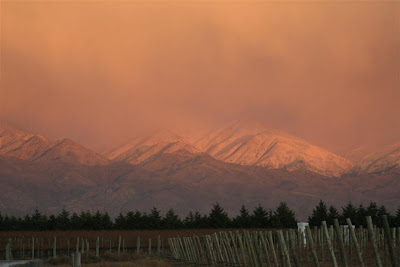
The scenery around Tupungato Divino, in the Uco Valley of the province of Mendoza.

 
Site Meter