Showing posts with label Uruguaya Customs. Show all posts

Saturday, May 2, 2009

To Kiss, or Not To Kiss?

The New York Times reports today that many New Yorkers are now squeamish about handshakes and air-kisses because of fear of transmission of swine flu. Not so in Uruguay, where a single kiss on the cheek as the usual greeting between friends and acquaintances is a deeply engrained part of the culture. Even now that the Uruguayan public health minister has confirmed that there is one suspected case of infection in the country, I don’t think people will think twice about kissing, and I hope they don’t.

There are slight variations in the custom for men and women. Men meeting for the first time usually shake hands only. However, male relatives and close friends will exchange a single kiss on the cheek. Kissing men on the cheek is in no way an affront to a man’s machismo. I have seen members of that uber-macho profession, the Policia, exchange a kiss in hello. Women, however, can kiss everyone. So, women kiss women and men; and men kiss women and close male friends and relatives. Got that?

The same goes for goodbyes. Just like my mother does in the U.S., much to the chagrin of my dad, when you leave a place you say goodbye to everyone individually. Not doing so is unthinkable. And of course, if you kissed them hello, you kiss them goodbye.

As for the kiss itself, it is a quick but sincere peck on the right cheek, not exactly an air-kiss and not a lingering pressing of lips to cheek – that would be icky. In Uruguay, they kiss once, not twice like they do in Italy.

Overall, Uruguayans are very polite, to each other and to foreigners. I think this kissing custom may have something to do with that. When a kiss is exchanged in greeting people, one is reminded of their humanity. There is less of a barrier between people and I think this makes them more considerate of others.

This is never okay, though, anywhere.

Tuesday, January 27, 2009

The Obligatory Mate Post

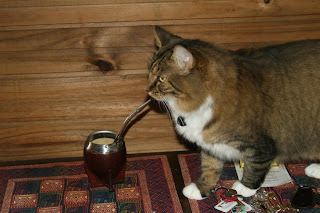
No, not “mate” as in Aussie speak or your partner – it is pronounced MA-tay and is the official beverage of Uruguay and Argentina. Just as many people in the US walk around with Starbucks cups glued to their hands, you couldn’t throw your half caf decaf with a twist (anyone get the movie reference? Post a comment if you do) and not hit an Uruguayo with a mate gourd in his hand – that is if you could get your half caf decaf with a twist… more on the sorry coffee situation here in a later post. I’m still too depressed to write about that one.


Remy likes mate too.


So, back to mate: Mate is an herbal infusion made from the yerba mate plant, which grows in Paraguay, and drunk in huge quantities in Uruguay, Argentina, Paraguay and parts of Brazil. It is an acquired taste. People unaccustomed to it describe it variously as grassy, like green tea, bitter or just plain awful. I happen to like it. The really cool and unusual thing about mate is that it is drunk from a gourd, not a cup, and you sip it through a metal straw called a bombilla. The bombilla is tapered at the end which goes into your mouth and the other end is spoon shaped with tiny holes to act as a sieve to keep the mate bits out of your mouth. Some uppity Argentines use tea bags instead, but that practice is met with scorn here.


Noah does not like mate.

My first experimentation with mate was not good. I did not realize there was a process one must follow to get drinkable mate. I ended up with a strongly bitter beverage and lots of powdery mate bits coming up through the straw. The result was quite unpleasant. Happily, I was inducted into the tradition of mate by true Uruguayos. Our dear friend Susana taught me that I must first soak the mate with cold water and push it down into the side of the gourd. Once it is good and packed, I then pour hot, not boiling water into the gourd. Once the straw is set in the packed mate, don’t move it or you will screw up the nice packing job you did when you poured in the cold water. From there, you can replenish the hot water whenever necessary. The mate can be used over and over again through out the day. There are all sorts of subtle variation on the process, and they are as individual as the drinker. I now have a fond memory of whiling away an hour before lunch sipping mate with Susana, her husband Jorge, Cesar and Tita, who showed me how to fill the gourd properly so as not to disturb the mate and how to pass it to my left to my friend. When the gourd made its way back to Tita, she would fill it, drink and pass it on. You can drink mate alone or with friends. Uruguayans are very sociable and usually a small group of friends will share a mate gourd.

Mate is every where here. At some gas stations you will even see vending machines that provide hot water for your thermos. Mate drinkers carry around thermoses (the preferred brand is Stanley) full of hot water so they can continually refill their gourds. Many people carry a specialized leather container just the right size for a thermos, bag of dry mate and the gourd. It is not uncommon to see people on mopeds, mate paraphernalia bag hanging from their shoulder and the mate gourd in one hand, leaving the other hand for the slightly less important job of steering the moped. The very adept mate drinkers can even hold the gourd with one hand and pour hot water from the thermos held under the armpit of the same arm, leaving their other arm completely free. If you see a lot of Uruguayos with burn marks on one hand, now you know why.

Snickers says "screw mate, I am an American cat, give me the tootsie pops!"

Wednesday, December 24, 2008

I Wanna Be a Gaucha

A couple of weeks ago I had the pleasure of meeting Manchita. This sweet horse is hanging out in Gloria’s pasture, providing her with free fertilizer. In addition to making the veggies grow, she is incredibly patient, gentle and excellent for children or beginning riders, like me. Sergio, her owner, is also very patient, and indulged my curiosity by bringing over a saddle and other horse accoutrements and allowing me to go for a ride. His English non-existent, my Spanish very basic, he managed to show me the basics of what in the U.S. we call Western riding.

I didn’t realize it until after I had dismounted with shaky legs, but I was a little nervous at first. I am not what I would call a “horsey” person. Never begged for riding lessons as a kid and have only been riding on horses in groups where my horse simply followed the others with little direction from me. Being on my own on a horse was new to me. It is also something I want to experience again.

Telling a Uruguayan you don’t know how to ride a horse is like telling a Hawaiian you don’t know how to swim. They seem mildly shocked and sorry for you. Horses are an important part of Uruguayan culture. The true gauchos may have ridden into the sunset, but most modern Uruguayans have some longing for gaucho ways. Foremost in gaucho culture is the horse. There is a saying that a gaucho without a horse is a man without legs.

Where we live, horses are everywhere. People ride as a pleasant pastime or simply as a way to get from place to place. Some people own horses, but not land. One sees these horses of landless owners hitched in fields by the roadside. Several times on our way home from town we have seen men on horseback leading a herd of other horses. Where they were going, I’ll never know.

I hope to get to know horses better. I am certainly in the right place to do it. I think with help from Manchita, I will.

Tuesday, November 18, 2008

Abre la puerta, cierra la puerta.

Good fences make good neighbors. True for property as well as human relationships, if boundaries are known, they can be respected.
In rural Uruguay, every property seems to have a gate, from the most humble to the grandest. Therefore, I find myself opening and closing gates often. Every time we leave our house in the car, we go through a ritual of locking everything up, driving to the gate, stopping at the gate for one person to get out of the car to open it and then lock it behind us.
When we visit our friend Gloria, she usually leaves the gate opening if she is expecting us at a particular time. Last April, when we visited the owners of the Alto de la Ballena winery, I recall opening and closing behind us no fewer than three gates.
So when you visit, be a good neighbor and close the gate behind you.
 
Site Meter